
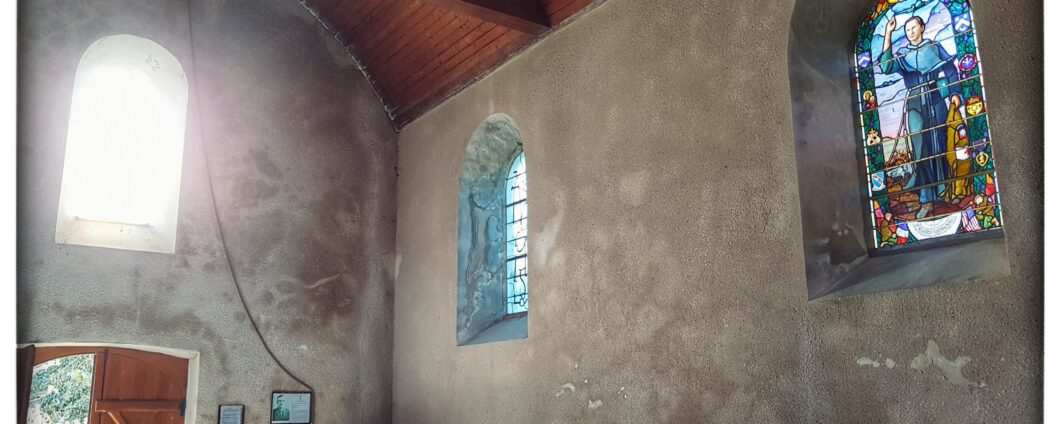
The Father Maternowski Remembrance Project partnered with the Beyer Studio in Philadelphia, Pennsylvania, USA to design and create a stained glass window for the Cauquigny Chapel in Normandy France. The window was installed and dedicated in June 2019.
Visitors to the Chapel can admire the intricate details of the design and symbolism throughout. Of note is the Douglas DC3/C47 transport plane depicted on the window. This plane carried the paratroopers across to Normandy, including the window artist’s father, SSgt. Joseph C. Beyer, the early morning of June 6, 1944.
A full list of the various symbols and what they represent is below.
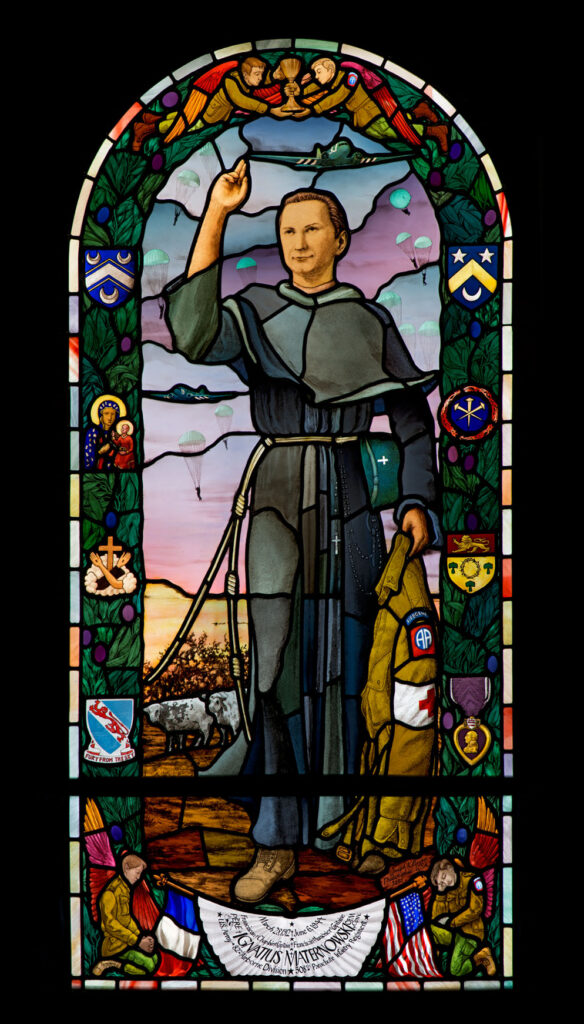
Left side of the window:
Coat of Arms of the City of Holyoke, Massachusetts, where Father Maternowski was born on March 28, 1912.
Our Lady of Czestochowa, honoring Fr. Maternowski’s Polish Heritage.
Coat of Arms of the Franciscan Friars Conventual, the order in which Fr. Maternowski professed his first vows as a Friar in 1932.
Coat of Arms of the 508 Parachute Infantry Regiment of the 82nd Airborne Division, of which Fr. Maternowski was the Regimental Chaplain.
Douglas DC3/C47 transport plane that carried the paratroopers across to Normandy. The crew of 3J included the window artist’s father, SSgt. Joseph C. Beyer, the early morning of June 6, 1944.
Paratrooper Angels are symbolizing the protection offered to the people of Normandy by their brothers in the American forces.
Right side of the window:
Coat of Arms of Amfreville, location of the chapel near the site of the fiercest D-Day battle.
Crown of Thorns, symbolizing Fr. Maternowski’s sacrifice.
The cross on the helmet indicating his role as Chaplain to the regiment.
Coat of Arms of Picauville, the municipal region containing the village of Gueutteville where Fr. Maternowski died and the location of his memorial.
Shoulder patch on the battle jacket representing the 82nd Airborne Division of the U.S. Army.
Purple Heart medal, awarded posthumously to Fr. Maternowski, for wounds received in combat.
Red Cross worn on the sleeve as an internationally recognized symbol of protection for the wounded and those caring for them. In addition to being the Regimental Chaplain, Father Maternowski also served as a medic, treating the wounded during the battle.
